Research / TSG series
Task Substrate Graph (TSG)
A Formal Model of Evolving Tasks
TSG investigates how a task can remain a persistent object while its actors, specifications, implementations, and relationships change. Humans, programs, models, and harnesses can realize the work at different times. The research object is the task's evolving structure, including changes to what the work means and what counts as a valid result.
Current working draft: 2026.10.4.3.1 · 28 October 2026. The draft develops a formal model and its boundaries; complete edge algebra, task-identity criteria, evolution policy, and general empirical validation remain open. The September PDF is a fixed historical preprint; later source revisions are retained privately and are not substituted for it. The preprint is not yet publicly listed on arXiv.
Overview: Research Object and Current Evidence
Research question: How can a task remain identifiable and analyzable as its actors, specifications, implementations and evidence change across long-running human–AI activity?
Evidence status: the September preprint provides an initial formal account and example task traces. Complete task-identity criteria, relation algebra, and comparative empirical validation remain open.
Key Figure and Model Evidence
This figure presents the proposed structure, exchange roles and evolution mechanisms. It does not itself demonstrate empirical superiority over existing task-persistence systems.
TSG Three Core Aspects
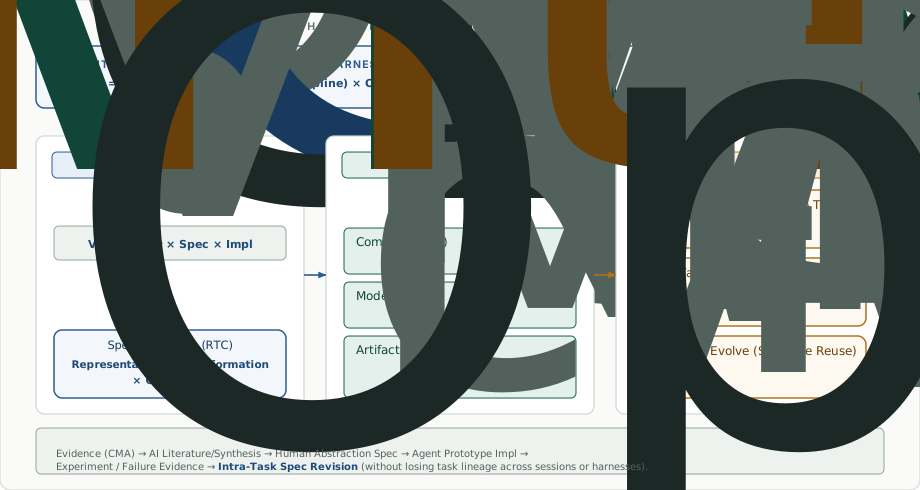
Semantic Context and Structural Core
The contextual coordinates are Owner × Location × Operation, with Location = (Intent, Discipline) and Operation ∈ {Consume, Digest, Create}. Owner answers whose task persists through handoffs. Actor identifies who is undertaking a concrete activity. Intent can describe exploration, explanation, optimization, or creation; Discipline locates the domain. These coordinates can be attached recursively to subtasks.
Consume acquires or observes state; Digest structures information into understanding; Create externalizes or modifies structure. They are primitive operation classes, not a mandatory three-step pipeline. Lightweight reading can retain a thin, implicit specification.
The structural core is G_T = (V_T, E_T), with V_T ⊆ Actor × Spec × Impl. A node relates an Actor to a Spec through an Impl:
| Coordinate | Meaning | What can vary |
|---|---|---|
| Actor | Human, AI, program, or collective undertaking an activity | Replace the executor; assign contextual reviewer/implementer roles |
| Spec | Relatively stable meaning and validity conditions | Elaborate or revise the specification as evidence changes |
| Impl | One concrete realization: procedure, prompt, program, workflow, experiment, or document structure | Substitute a realization under the applicable Spec |
Inside Spec, RTC = (Representation, Transformation, Constraint) specifies the structured object, its meaningful/admissible changes, and conditions to preserve. RTC is internal to Spec, rather than another graph axis. Typed edge families may include dependency, flow, refinement, realization, synchronization, replacement, and evidential influence; a complete edge algebra is still under development.
Activity-Relative CMA Roles
Component, Model, Artifact describe exchange roles relative to an activity. They are not globally exclusive file types or additional dimensions of the core graph.
| Role | Meaning in the current draft | Example |
|---|---|---|
| Component | Reusable capability, structure, or functional unit | Software module, retrieval capability, experiment procedure, task fragment |
| Model | Representation used to reason about the task or an external domain | Formal grammar, simulator, statistical predictor, or reified task graph |
| Artifact | Materialized output or state carrier | Code, document, dataset, figure, checkpoint, serialized graph |
A file may materialize a Model and serve as an Artifact in another activity. A concrete TSG graph is itself a Formal Task Model; reifying it allows it to be exchanged as a Model. Such recursive reuse does not identify all Models with TSG.
Instantiation and Two Scopes of Evolution
Instantiation applies the formalism to context: Instantiate(TSG, Context_T) ⇒ G_T. It is not a third runtime dynamic or a separate graph instance for every step.
Intra-Task Evolve changes one persistent graph: G_T(t) → G_T(t+Δt). Changes can replace an Actor or Impl, revise Spec/RTC, add or remove edges, revise CMA bindings, or branch and merge work. Whether a revision preserves task identity is an open semantic obligation, rather than something established by sharing a thread ID.
Inter-Task Evolve captures how reusable Components, Models, Artifacts, or graph structures change another task. Reuse needs to consider the receiving Spec and inherited assumptions. Copying an artifact or observing successful reuse does not by itself establish a general admissibility theory.
Negative Evidence and Specification Revision
A failed experiment can reveal an implementation defect, insufficient measurement, or a limitation in the motivating hypothesis. The proposed evolution account distinguishes observed outcome → interpretation (Digest) → proposed Spec/Impl revision → check and adoption. Recording a failure establishes history; showing which admissible choices it changes requires further evidence.
Relations such as informed_by, supports, refutes, refines, and validates have different strengths. They are candidate relation types to formalize, not established primitives. Chronological proximity alone cannot supply causality or validity.
For example, in an SSG-DT research task, an inaccurate prediction is an Artifact of an experiment. Diagnosis may change the implementation, the representation of contention, or the evaluation constraints. TSG would record which of these changed and why, while SSG-DT models the physical computation under study.
Neighboring Systems and Semantic Boundaries
The current draft treats persistent execution and research systems as substantive comparators:
| Neighbor | Relevant capability described in the draft | Remaining TSG question |
|---|---|---|
| Delta / DeltaDB | Conversation, code operations, worktrees, and collaborative history | When does an edit revise Impl, change Spec, or create a distinct task? |
| Athanor | Durable experiment records, jobs, results, and checkpoint lineage | How do experiments revise task meaning and admissible RTC? |
| CIG | Explicit evidence/hypothesis/intervention/outcome improvement state | Can semantic task evolution be represented beyond a fixed improvement target? |
| Euler | Domain-specific research contracts, obligations, evidence, and verified facts | Which structures generalize beyond its mathematical domain? |
| CORTEX / GitSwarm | Verified reuse or cumulative contribution lineage | How does adopted experience change the receiving task's Spec and identity? |
| SCARCE | Cross-task commitments and actor-relationship state | Which relations belong to actor context, and which govern a particular task? |
| FAOP / PAP–Touba | Typed workflows and rewriting; responsibility and guarded dispatch | How do workflow/authorization contracts relate to changing task specifications? |
These comparisons follow the October manuscript and are not new integration claims. In particular, task ownership does not confer operational permission, and evolution of task meaning does not replace a runtime's authorization mechanism.
Relationship to Three Models, SSG, and a Workbench
Three Models supplies a general modeling perspective. TSG is currently a formal task-world research line; it need not reproduce SSG's FP/PP/LP engineering sequence. SSG models heterogeneous execution including Agent workloads, and can realize selected computational activities. Conversely, a TSG instance can represent the research process that constructs SSG. These are parallel research series with possible interfaces, rather than a mandatory frontend/backend chain.
A future Workbench would retain task snapshots, active specifications, object lineage, evidence, substitutions, and adoption decisions across human and AI actors. The formal model does not prescribe one scheduler, approval protocol, or harness. Open research includes task boundaries, RTC semantics, edge composition, CMA typing, and evaluation against strong persistence/reuse baselines.
Current Draft Lineage
| Date | Snapshot | Change |
|---|---|---|
| 2026-10-28 | 2026.10.4.3.1 |
PAP/Touba responsibility and admission comparison; retains earlier formal structure and literature |
| 2026-10-19 | 2026.10.3.1.1 |
FAOP workflow normalization/type/effect comparison |
| Earlier October revisions | Athanor/SCARCE archive line | Experiment lineage, actor relationships, DeltaDB, and task/evolution boundaries |
Full Paper (PDF)
Historical Lineage: TLI and Workbench to TSG
The TSG manuscript synthesizes two earlier August 2026 research tracks into a single substrate formalism:
| Stage | Manuscript | Core Focus | How It Entered TSG |
|---|---|---|---|
| Precursor A | Task-Level Intelligence: Task Substrate Graphs for Recursive Intelligent Creation (private archive) (Aug-V4.2, 29 pp.) |
Asks what lies above the agent harness; introduces the TSG name and typed Intent / Representation / Transformation / Constraint specifications | Became the step-level Spec = R x T x C and Intent(E x F x P) coordinates inside V_T |
| Precursor B | Toward an AI-Native Workbench: Unifying Consume, Digest, and Create (private archive) (Aug-V0.1, 28 pp.) |
Organizes AI work around persistent human activity instead of applications; introduces Consume / Digest / Create and Location | Became the persistent object layer O, CDC macro-operations, and empirical case-study workbench |
| Unified Track | Task Substrate Graph: A Formal Model of Evolving Human–AI Tasks (Sep-V3.1.13, 27 pp.) |
Substrate-level task graph G_T, activity-relative CMA roles, and Instantiation / Intra-Task / Inter-Task Evolve |
Unifies step-level cognitive specs and hub-level lifecycle into a general task-world substrate |
Version History
| Date | Version Tag | Artifact / Snapshot | Substantive Changes & Provenance |
|---|---|---|---|
| 2026-09-20 | Sep-V3.1.14 |
Source .tar.gz (private archive) | Representation-framing revision; reframed runtime protocols (propose -> apply, approval gates) as reference implementation choices rather than core graph semantics. |
| 2026-09-20 | Sep-V3.1.13 |
Compiled PDF | Preprint dated 24 September (27 pages): restored architecture figures, 24-entry bibliography, three end-to-end human–AI task traces. |
| 2026-09-18 | Sep-V3.1 |
Draft milestone | Completed four-axis context (Owner x Actor x Location x CDC) and CMA role formalization across research, engineering, and creative tasks. |
| 2026-08-19 | TLI Aug-V4.2 |
Precursor PDF (private archive) | Task-Level Intelligence draft (29 pages): TSG name, typed IRTC specifications, multi-domain protocols. |
| 2026-08-19 | Workbench Aug-V0.1 |
Precursor PDF (private archive) | Toward an AI-Native Workbench draft (28 pages): Consume / Digest / Create, Location, and materialization across tools. |
Explore Companion Series: SSG → · Explore Methodology: Three Models → · All Publications